🛡️Fully Insured·Full Liability + Equipment Coverage·Certificate Of Insurance Available On Request
Service · Mattoon, IL · Built To NRCS Spec

Conservation Drainage & Water Management

Controlled-drainage structures, saturated buffers, and denitrifying bioreactors — built to NRCS spec. The edge-of-field practices almost nobody around here will build. We will. Across the 60-mile radius from Mattoon.

📞 Call (217) 809-0779 Free Estimate

Drainage Water Management — Built Right, Built To Spec

Standard tile drains your field all the time. Conservation drainage gives you a say in it — hold the water back when the crop doesn't need it gone, let it run when it does, and treat what leaves so it does less damage downstream.

These are the edge-of-field conservation practices NRCS pushes hard in central Illinois — and the ones most local drainage contractors won't touch. They take a contractor who'll work to the conservation spec, off the stake, with the right iron. Brohez Trucking LLC builds them: controlled/managed drainage structures, saturated buffers, and denitrifying bioreactors, all on the same tile systems you already run.

It's still earthwork. It's still tile, structures, gravel, and grade — the work we do every week. The difference is the spec. We build to the NRCS Conservation Practice Standard the plan calls for, on the elevations the technician stakes, so it passes inspection and actually works.

Got an approved conservation plan, or working with your county NRCS or Soil and Water Conservation District office? Call (217) 809-0779 and walk it with me. Bring the plan if you've got one.

What We Build & How

Three edge-of-field practices, one crew, the same standards we hold on every job.

NRCS 554

Controlled / Managed Drainage

A water-control structure on the tile main — stoplogs or a gate that lets you set the water level the tile drains to. Raise it after harvest and over winter to hold water back; lower it before fieldwork and through the growing season so the ground drains. We set the structure on a stable base at the staked elevation, tie it into the main, and build it to NRCS 554 controlled-drainage spec.

NRCS 604

Saturated Buffers

Instead of dumping tile water straight out the outlet, a saturated buffer routes it through a control structure into a perforated distribution line running along an existing grass buffer by the stream. The water seeps through the soil and the root zone before it reaches the ditch. That's a tile-plow and excavator job — we install the structure, plow in the distribution line to NRCS 604 spec, and tie it back to your tile.

NRCS 605

Denitrifying Bioreactors

A buried woodchip-filled trench that tile water is routed through on its way to the outlet. We excavate the trench to the design dimensions, set inlet and outlet control structures, place and grade the woodchip media, cap it, and connect it to the tile main. Built to NRCS 605 bioreactor spec, finished and seeded over the top.

The Equipment To Do It Right

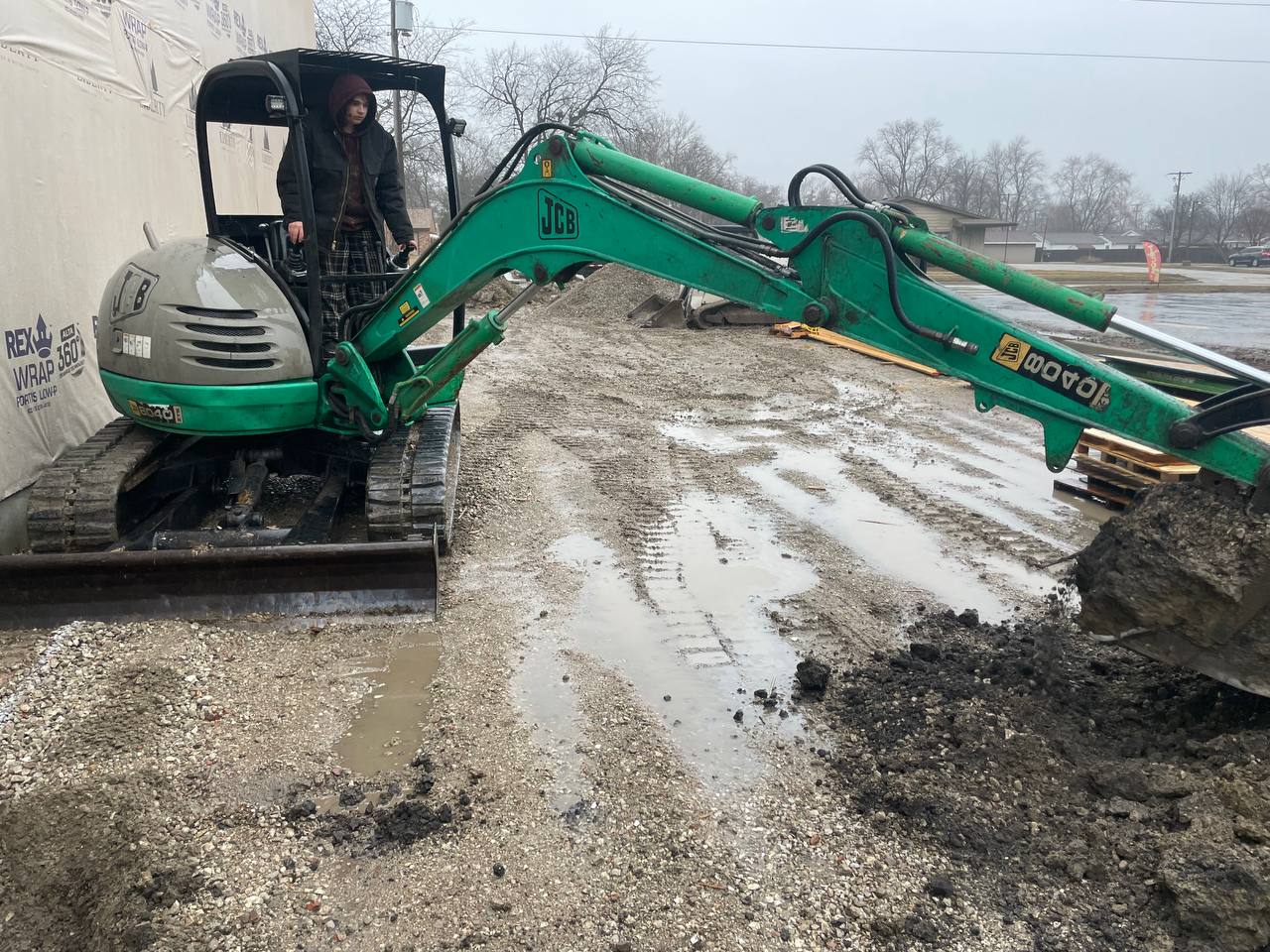
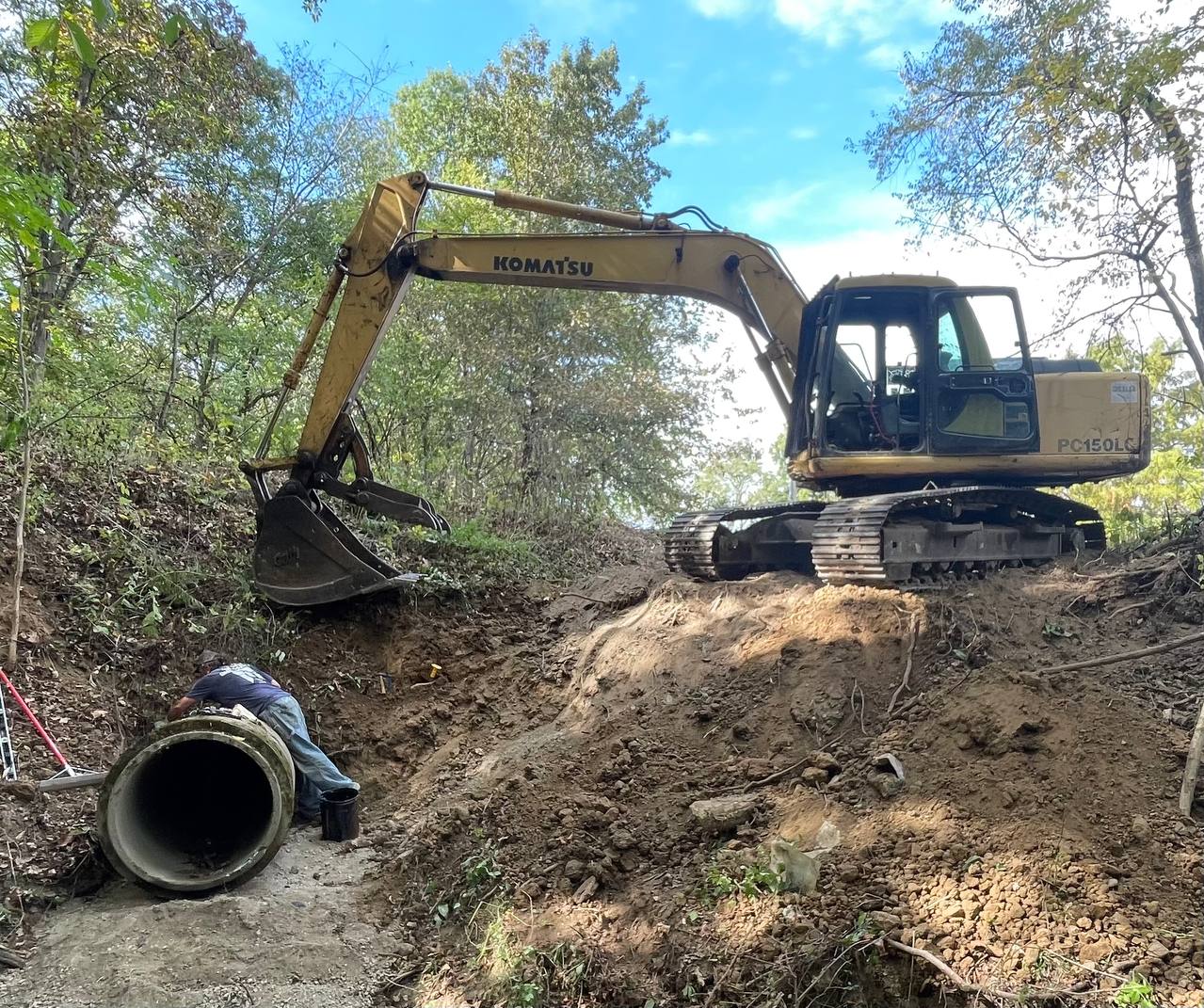
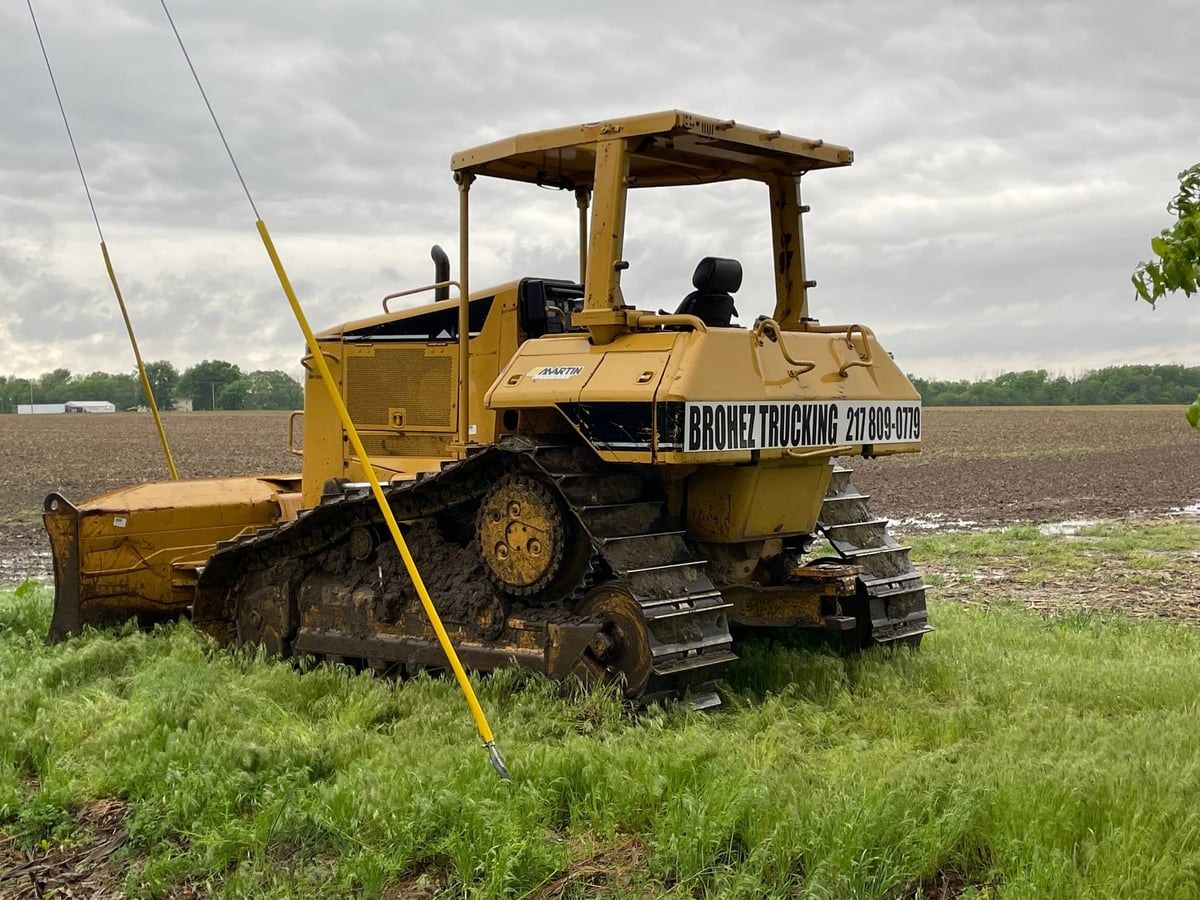
Conservation drainage isn't a specialty machine — it's the right earthwork iron used to a tighter spec. We run our own fleet, so the excavation, the structures, the media, and the finish are all one crew, one schedule, one number.

From Plan To Pass

  1. You get the practice planned. If you haven't yet, your county NRCS or Soil and Water Conservation District office sets up the conservation plan, the design, and the staking. Then we come in.
  2. Walk it together. Levi walks the field with you and the staked plan. We confirm access, where the structures go, where spoil and media stage, and the schedule.
  3. Locates & layout. Utility locates get called before any digging. We mark the structure locations and trench lines so you can see the work before it goes in.
  4. Excavate & set structures. Trench the bioreactor or the buffer line to grade, set the control structures on a stable base at the staked elevations, and tie into the tile main.
  5. Place media & backfill. Woodchip media into the bioreactor, gravel and bedding where the spec calls for it, backfilled in lifts so nothing settles wrong.
  6. Finish grade & cover. Topsoil respread, surface graded smooth, seeded or restored so the field and the buffer come back.
  7. As-built & walkout. Final inspection with the technician, signed-off as-built, and you've got water management you control.

Central Illinois Counties

We serve a 60-mile radius from Mattoon — most of east-central Illinois farm country. Counties we regularly run conservation and drainage jobs in:

Coles County Moultrie County Shelby County Cumberland County Effingham County Douglas County Edgar County Champaign County Macon County Christian County Clark County Jasper County

Don't see your county? Call and ask — if it's within driving distance of Mattoon we'll usually take a look.

Conservation Drainage FAQs

What is drainage water management?

Holding back drainage water when the crop doesn't need it drained, and letting it run when it does. Instead of an open tile outlet draining all the time, a control structure lets you set the water level the tile drains to. Same tile system you already understand — with a gate on the outlet.

Do you build controlled-drainage structures to NRCS spec?

Yes. We install controlled/managed drainage structures built to NRCS Conservation Practice Standard 554 — set on the main at the staked elevation, on a stable foundation, with the stoplogs and water-level controls the design calls for. Built to pass inspection.

What's a saturated buffer and can you install one?

A saturated buffer (NRCS 604) reroutes tile water through a control structure and a perforated distribution line along an existing grass buffer near the stream, so the water seeps through the soil instead of dumping out the outlet. Yes — that's a tile-plow and excavator job, exactly the iron we run.

What's a denitrifying bioreactor?

A buried woodchip-filled trench (NRCS 605) that tile water is routed through before the outlet. We excavate to the design dimensions, set the inlet and outlet structures, place the woodchip media, cap it, and tie it back to the main. An earthwork install within our wheelhouse.

Does Brohez have the equipment to build these?

Yes. Komatsu PC150LC excavator for the structures and trench, Cat D6N dozer for shaping and the buffer area, tile plow for the distribution lines and tile ties, and dump trucks for woodchip media, gravel, and spoil. One crew, start to finish.

Who else builds conservation drainage around here?

Not many. Most local drainage contractors stick to standard pattern tile and repair. These edge-of-field practices take a contractor willing to work to the conservation spec — we are. Got an approved plan or working with NRCS or your SWCD? Call us.

What areas do you serve?

60-mile radius from Mattoon, IL — Coles, Moultrie, Shelby, Cumberland, Effingham, Douglas, Edgar, Champaign, and Macon counties. Decatur, Champaign, Effingham, Charleston, Urbana, Sullivan, Tuscola, Shelbyville, Pana, and Terre Haute.

Conservation Drainage Across Central Illinois

Brohez Trucking LLC builds conservation drainage and water-management structures across a 60-mile radius from Mattoon, IL — into Coles, Cumberland, Douglas, Shelby, Moultrie, Effingham, Edgar, Clark, Champaign, and Macon counties, plus over the line into Vigo County, Indiana. Pick your town below for local details, or call (217) 809-0779 for a free estimate anywhere in the radius.

Got A Conservation Plan To Build?

Walk the field with me. Bring your NRCS plan if you've got one. We'll tell you what the job actually takes — no pressure, just a straight number.

(217) 809-0779 📞 Call For Free Estimate Send A Message

Open daily, 7am–7pm · Mattoon, IL · 60-mile service radius