Before a building comes down you need the permit where one applies, the asbestos question answered, every utility disconnected and capped, a JULIE 811 locate on file, and on rural ground the septic and well properly handled. Those five steps are what separate a clean teardown from an expensive one, and the order matters as much as the list. Brohez Trucking LLC walks the site, tells you which of them your job actually needs, and handles them — house, barn, garage and outbuilding demolition inside 60 miles of Mattoon, Illinois. Call or text (217) 809-0779.
The machine is the short part. Before a building comes down we walk the site and hand you an itemized quote, confirm what permit the address needs, sort the asbestos question by building type — a single-family house is exempt from the survey and the IEPA 10-working-day notice; a commercial, institutional or ag building is not — get the JULIE 8-1-1 locate called, and make sure public utilities are off. Electric, gas and water disconnects are your call as the account holder, and they are the most common reason a date slips. Then the building gets cleared out, comes down, the foundation comes out, and the ground gets graded clean. Free estimate: (217) 809-0779.
People picture demolition as the dramatic part — the machine, the building coming down, the dust. And honestly, that is the easy part. The work that actually matters happens before the excavator ever touches the building. Do those steps right and the job is safe, legal, and clean. Skip them and you get somebody hurt, a hit gas line, a red-tag from the state, or a buried hazard the next owner finds the hard way.
So here's the honest walkthrough of what we do before we tear down your barn, house, or outbuilding — start to finish.
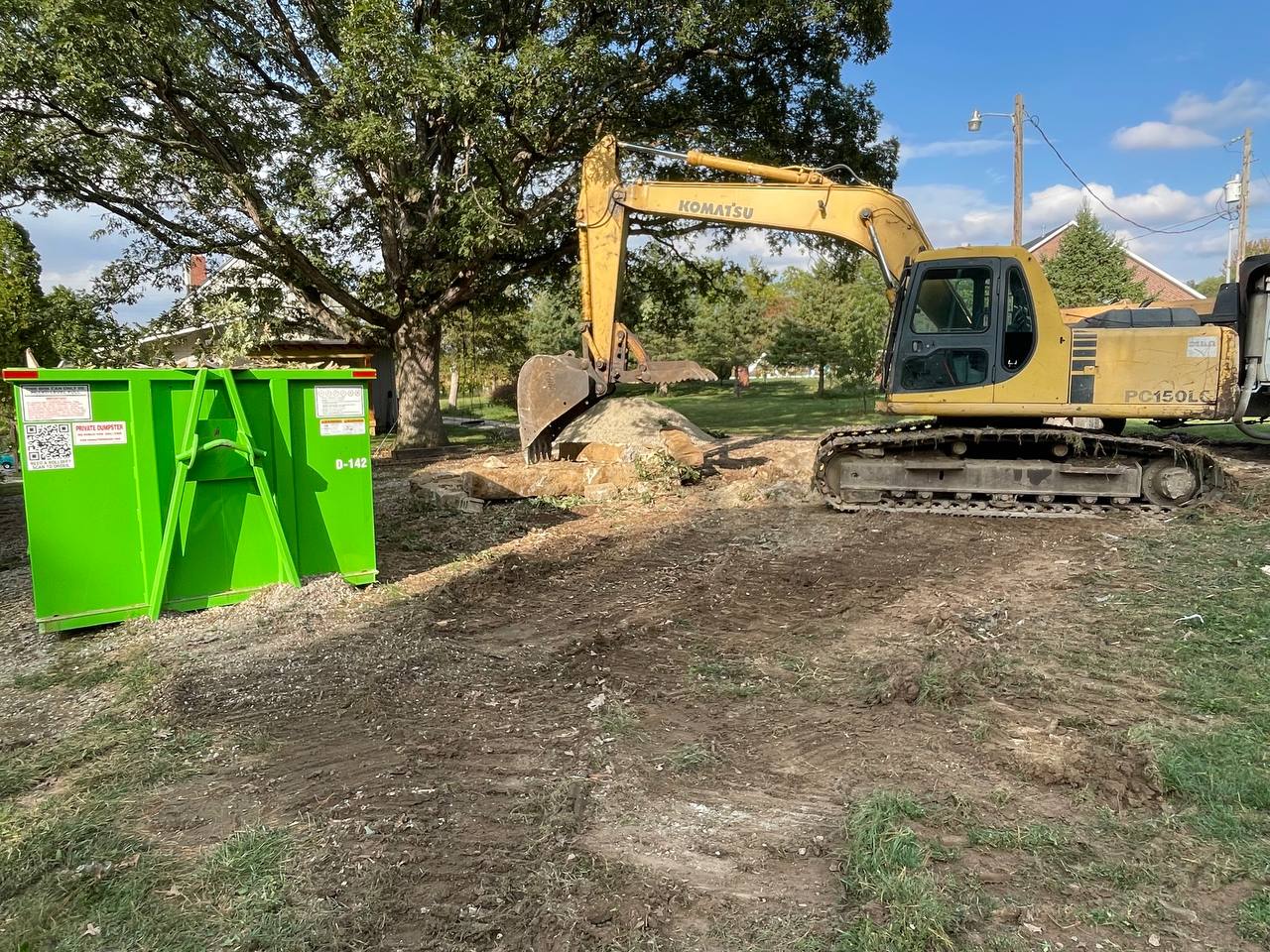
1. We Walk the Site and Give You a Straight Quote
Everything starts with Levi walking the site with you. We look at the building, figure out exactly what's coming down, whether the foundation or slab is part of it, how we'll get a machine and trucks in, and what has to be cleared out of it first. Then you get a straight, itemized, free estimate — not a per-square-foot guess off a photo. You can read more on how we price it in our cost-to-tear-down-a-barn post.
2. Permits and the Asbestos Notification
This is the step most people get backwards, and it's the one that can set the timeline. The trigger is the building type, not the building's age. A single-family private residence is exempt from the federal NESHAP asbestos survey and the IEPA 10-working-day notification — no inspector, no waiting period, so on a house teardown this step never holds your date. A commercial, institutional or agricultural building is not exempt: a licensed inspector surveys it first and the 10-working-day notice goes to Illinois EPA before anything comes down. So on a barn, that clock is real; on your house, it isn't.
3. Utilities Off and a JULIE 811 Locate
Nothing comes down with live service to it, and the split here matters. Electric, gas and water have to be disconnected and removed at the meter by the utility companies, and only you as the account holder can make that call — nobody else can order it, which is why it is the single most common reason a teardown date slips. Make those calls early. What we handle: the JULIE 8-1-1 locate before any digging, so the underground lines get marked and the excavator never finds a live one the hard way; any private utilities such as a well or a propane tank; and capping the sewer. Tell us at the walk-through what's out there and we'll tell you which side of the line it falls on.
4. Septic and Well — Handled, Not Ignored
On a lot of rural teardowns there's an old septic system or a well in play, and these can't just be left.
- Septic tank. An abandoned tank gets pumped and properly collapsed or removed so there's no hidden void in the ground that someone — or a tractor — drops into later.
- Well. An old or abandoned well gets capped to code, so it isn't a hazard or a path for contamination.
This is exactly the kind of thing a fly-by-night crew skips and a careful one doesn't.
5. Cleared Out, Then the Teardown
Anything you want out of the building, take it out before we mobilize — tools, equipment, fixtures, whatever it is, it's your property. Once we're on site the building comes down as a unit; we don't hand-pull material out of it. (Still deciding whether it has to come down at all? That's its own question, and we walk through it in Is Your Old Barn Worth Saving?.) Then the building comes down in a controlled way — not just shoved over — and the debris gets sorted, processed, and hauled off. Clean metal goes to scrap, concrete to the right place, only true trash to the landfill.
6. Foundation Out and the Site Graded Clean
The last step is the one that makes it look like the building was never there. If the plan is to remove the foundation or slab, it comes out, the hole gets backfilled and compacted in lifts so it won't settle, and we grade the site clean and level. Whether you're rebuilding, putting it back to field, or just want a tidy yard, you're left with ground that's ready — not a mess and a soft spot.
What Is Required to Demolish a Building?
Short version, and it is the six steps above in one place. To demolish a building in Illinois you need a permit where the structure sits inside a city or village, an asbestos determination driven by the building type rather than its age, every utility disconnected and capped, a JULIE 811 locate before anything digs, and — on rural ground — the septic and the well dealt with properly instead of buried. After that it is the teardown itself, the foundation, and the grade left clean behind it.
What changes from job to job is which of those actually apply. A detached garage on a single-family lot in town needs the permit and the utility cut-offs and almost nothing else. A commercial building needs the survey and the 10-working-day notification whatever its age. A barn on unincorporated county ground may need no local permit at all and still needs the locate. The order matters as much as the list — a permit pulled after the fact is a different and more expensive conversation than one pulled first.
Why the Process Is the Point
Anybody with a machine can push a building over. What you're actually hiring is the part you don't see: the notification started on time, the locates done, the utilities killed, the septic and well handled, and the site left clean and safe. That's the difference between a demolition done right and a liability you inherit.
Got a building you're ready to be rid of? Here's our full demolition service — or just call (217) 809-0779 and we'll walk it with you.
"We hired Levy for a large demo job and dirt removal. They showed up on time, worked hard, and completed the job faster than I expected. What impressed me most was how clean they left the site afterwards — no mess left behind."
"Great Service and Great Price! They continued working for 3 days to demolish three buildings and removed all the debris to dumpsters that I ordered. Then, they also came in with dirt to fill the whole backyard. Strongly recommended!"
"Very responsive, fair pricing, and easy to work with. Did a great job for our project."
Every one of these is a real Google review from a real central Illinois customer — see them all on our reviews page.