A water line trench is six steps: walk and route it, call locates, open the trench below frost, bed the bottom, let the plumber lay and connect the pipe, then backfill in lifts and grade it back. We do the hole; a licensed plumber or the water department does the pipe and the connection. Depth is the part people underestimate — around here roughly 42 inches of cover is the common target on a water service. Free on-site look before anybody digs — our water line trenching work, or call (217) 809-0779.
New house on a rural lot. A shop that needs water out back. An old galvanized service that's been patched twice and finally gave up. All three end the same way: somebody has to open a trench from the main, the meter or the well to the building, and put it back so you can't tell it was there.
Here's what that actually takes on a central Illinois property, in the order it happens.
Who Does What On A Water Line
Worth settling first, because it's the thing people are least sure about when they call.
We're an earthwork contractor, not plumbers. On a water line, we open the trench, bed it, and backfill and grade it back. Your licensed plumber or the water department taps the main, lays and joins the pipe, sets the meter or the curb stop, pressure-tests it, and pulls the trade permit. We don't make plumbing connections and we don't pull plumbing permits.
That's not a limitation, it's how the job is supposed to run — and knowing it up front saves you from hiring the wrong trade first. Same split we spell out on the trenching service page for every utility line we open.
Step 1: Walk It And Pick The Route
The straight line between two points is often not the trench you want. What we're looking at on the walk:
- What the route crosses. A driveway, a septic field, a patio, a mature tree's root plate, an existing tile line. Every one of those is either a detour or a more expensive crossing.
- Machine access and spoil room. The trench itself is narrow; the dirt out of it is not. On a tight lot the question is where the spoil piles live for the day without killing the lawn under them.
- Grade and drainage. A trench line that runs downhill toward the house is a channel for surface water if it's backfilled loose. Route and backfill get decided together.
- Where the plumber needs it to end. The entry point into the building and the connection at the far end aren't ours to pick. We dig to their points.
The walk is free, and it's also when the depth question gets settled — covered in detail in how deep a trench needs to be in Illinois.
Step 2: Locates, Before Anything Moves
JULIE gets called on every dig, no exceptions, and the locates have to come back before a bucket touches ground. That's the part that sets the calendar — the dig can't be tomorrow if the call goes in tomorrow.
Two things people don't expect. First, marked utilities routinely change the route: a gas service running exactly where you wanted the water line means the water line moves or crosses at a controlled point. Second, locates only cover the public side. A run out to a shop, a yard light, an invisible fence, an irrigation loop, an old well line — those are private and nobody marks them. If you know something's out there, tell us. If you think something might be out there, tell us that too.
We mark the trench line before we start so you can see exactly where it's going while it's still just paint on grass.
Step 3: Open The Trench, Below Frost
A water service holds standing water any time nobody's running a tap, which means it has to sit below the frost line or it splits. Design frost depth in central Illinois generally runs in the 30 to 36 inch range, and the figure most jurisdictions around here work to on a water service is roughly 42 inches of cover. Your plumber and the water department give us the number that binds on your job.
Two details that get missed:
- Depth is measured from finished grade. If the yard is getting cut down after the line goes in, the trench has to be deep enough to still be below frost when the dirt work is done.
- Bare and plowed ground freezes deeper than sod. A section running under a gravel drive sees frost further down than the same line under lawn.
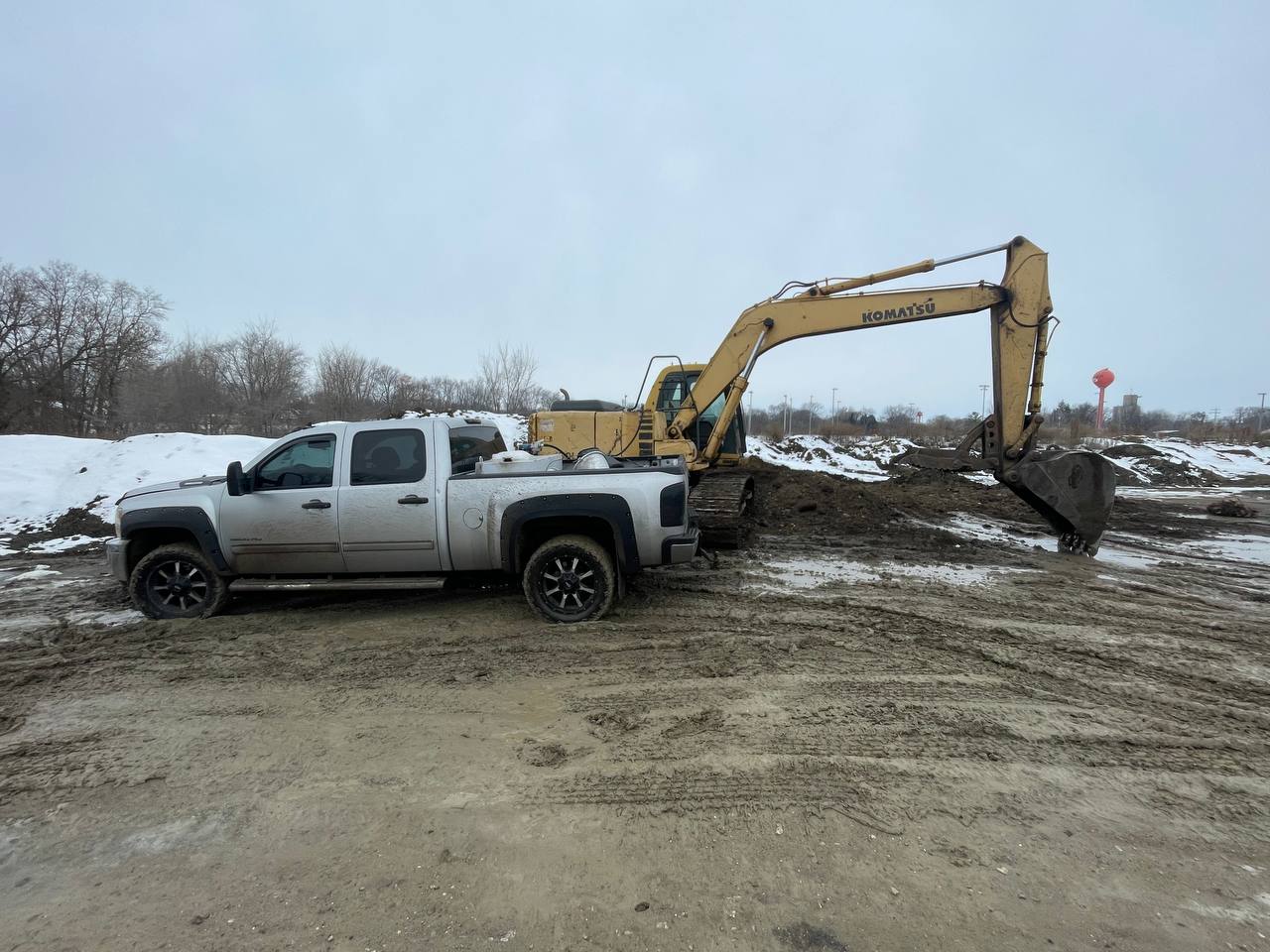
On our end, the machine matters here. The Komatsu PC150LC-6 has the reach and the bucket for a full-depth service run; the JCB 8040ZTS mini is what goes between the house and the fence on a tight lot without tearing the place up getting there.
Step 4: Bed The Bottom
Trench bottoms come out rough. Clods, a rock, a hard clay high spot — lay pipe straight onto that and you've built point loads into a line that's supposed to sit there for decades under pressure.
So the trench gets taken a little past grade and brought back up with bedding material, so the pipe rests on something uniform the whole way. The same material goes back over the top before general backfill starts, so the first thing landing on your new line isn't a shovel of clay chunks. It's a small step and it's the cheapest insurance on the whole job.
What we bed with depends on what's in the hole — clean stone in wet or soft ground, screened material in others. It's a call made in the trench, not from the office. If you want the background on the materials themselves, which gravel do I need covers what each one is for.
Step 5: The Plumber's Half
With the trench open and bedded, the plumber's crew is in it: pipe rolled out and joined, tracer wire run so the line can be located later, the tap or the connection at the main or meter end, the entry into the building, then pressure test and inspection.
Our job during that window is to stay out of the way, keep the trench safe and open, and be ready to close it the moment they release it. Trench walls are not a thing anybody gambles with — an open trench of any real depth gets treated as a hazard, and deep ones need a protective system and a competent person on site under the trench-safety rules. Walls that look perfectly solid come in without warning.
Step 6: Backfill Is Where Jobs Are Won Or Lost
Anybody can push the pile back in. That's also why so many yards have a long shallow ditch across them a year after the water line went in.
Backfilled right means:
- In lifts, compacted as it goes — not one shove of the whole pile.
- Crowned slightly over the line, because backfill settles no matter how well it's done. A trench that finishes dead flat finishes as a dip. One that finishes proud settles level.
- Excess spoil hauled off if there's more than the yard can absorb, rather than spread into a ridge you mow around.
- Surface bladed smooth and ready to seed. Field ground gets disced back ready for the next pass.
Under a driveway or a road crossing, compaction stops being cosmetic. Loose backfill under a drive is a dip in your gravel by next spring and a cracked slab if it's concrete.
Crossings, Barns And Hydrants
Three variations that come up constantly around here:
Driveway crossings. Cover requirements go up under traffic and the backfill has to be compacted properly in lifts. If the drive is gravel we can put it back and re-blade it; if it's concrete or asphalt, the surface repair is its own scope and worth pricing before you commit to the route.
Barns, shops and outbuildings. Long runs across open ground are usually the easiest water line work there is — room to work, room for spoil, no landscaping to protect. Length costs, but open ground is cheap ground to dig.
Yard hydrants and livestock waterers. The catch here isn't the pipe, it's the fitting: the hydrant's shutoff and drain have to sit below frost as well, or the line stays fine and the hydrant freezes anyway. Plan the depth around the fitting, not just the run.
One Trip, While The Machine Is There
Since an excavator is already on site with an open trench across the yard, it's worth asking what else should go in the same hole or the same day. Downspout and sump discharge lines out to daylight are the classic one — the cheapest fix there is for a wet basement wall, and it costs almost nothing extra while we're already there. A French drain along a problem wall, a yard drainage line, or a footing drain tie-in all fall in the same category.
Two trips cost more than one. That's most of the reason we ask what else is on your list before we mobilize.
Planning A Water Line?
Tell us where the water's coming from, where it's going, and what's between the two, and we'll walk it and tell you what the trench takes. We open, bed and backfill water service trenches across Coles County and out to Charleston, Effingham, Decatur, Champaign, Tuscola and Sullivan — residential services, shop and barn runs, hydrant and waterer lines.
Call or text (217) 809-0779 for a free on-site estimate, or see the full trenching service page for everything else we open a trench for.