Just want the pool gone? This page explains what moves the price. If you are ready to book the work, our pool removal page has the crew, the equipment, and a free on-site walk — or call (217) 809-0779 and talk to Levi.
How much it costs to fill in a pool in central Illinois is a scope, not a number. Six things move it: how much of the shell actually comes out, what the shell is made of, how the water gets drained and where it can legally go, how much import fill the hole swallows, how tight the backyard access is for a machine, and how far the spoil and debris haul. Full removal and fill-in are both real options and we quote both. The site walk and the itemized number are free: (217) 809-0779.
Why won't you just put a price on this page?
Because filling in a pool and removing one are two different jobs, and a single posted number would have to pretend they are one. The shell, how much of it comes out, where the water can legally go, and how many loads of fill the hole swallows all move it — and backyard access moves it hardest, because a machine that cannot get around the house changes the whole method. What I will promise instead: you get both options priced, itemized and free, after I stand in the yard. Text a photo or call (217) 809-0779.
How much does it cost to fill in a pool? That's where almost everybody starts, and the honest answer is that swimming pool fill-in cost isn't one number — it's a scope. The cost to fill a pool with dirt turns on how much of the pool actually comes out, what the shell is made of, how the water gets drained, how much import fill the hole swallows, and how hard your backyard is to get a machine into. Below is what moves each of those, so you can read your own yard before anybody puts a number on it.
An old in-ground pool nobody swims in anymore is one of those things that just costs you — chemicals, a cover, liability, and a chunk of backyard you can't use. We fill in and fully remove in-ground pools across central Illinois, insured, with our own excavator and trucks. Both are real options and we quote both.
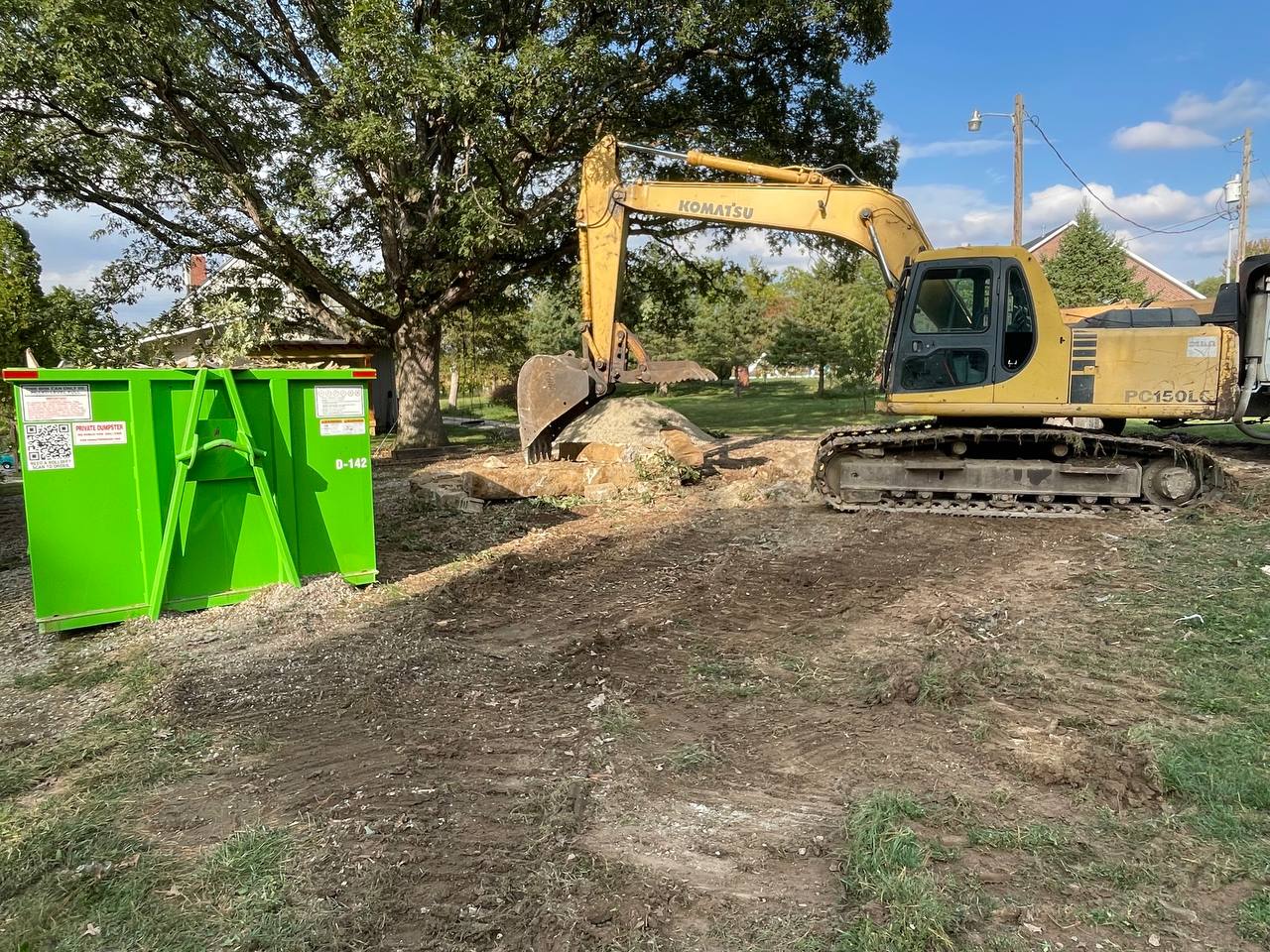
How Much Does It Cost To Fill In A Pool? Six Things Set The Number
A fill-in isn't a single product. Ask three contractors how much it costs to fill in a pool and you can get three wildly different numbers for what sounds like the same job — because they're quoting different amounts of demolition, different fill material, and different levels of compaction under the same word. Here's what's really being priced:
- How much of the pool comes out. The single biggest lever. Punching the bottom and folding the top of the walls in is a different day than breaking out and hauling the entire shell. Everything else on this list is smaller than this one.
- What the shell is made of, and how big it is. Concrete and gunite are a heavy break-out. Vinyl-liner walls and fiberglass shells come apart differently. A deep-end pool is more shell and a much bigger void than a shallow one.
- Draining the water, and where it can legally go. Thousands of gallons have to be let down somewhere that isn't the neighbor's basement or an overloaded storm drain.
- How much import fill the hole takes. A pool is a big void. Spoil from the excavation and the collapsed decking fill part of it; the rest gets trucked in. Fill and truck time are a real share of any fill-in.
- Backyard access. Whether an excavator and a tandem can actually get to the hole — and get the debris back out — changes the hours more than people expect.
- Haul distance and disposal. Out in the country, every load of broken concrete is truck time plus a tipping fee at the far end.
Notice what isn't on that list: a square-foot rate. There isn't an honest one, which is why the last section of this page explains why we walk the yard instead of posting a number.
The Cost To Fill A Pool With Dirt — And Why "Dirt" Is The Wrong Word
When somebody prices the cost to fill a pool with dirt, what they're describing is properly called a partial removal and fill-in, or pool removal by fill-in — the industry also calls it abandon-in-place. It's a legitimate, permitted way to be done with a pool. It is not backing a truck up and dumping topsoil into a swimming pool, and the difference between those two jobs is the whole ballgame.
1. Break the bottom before anything goes in
A pool shell is a watertight bowl. Leave it intact under a yard and you've built an underground bathtub: rain and subsurface water work down through the fill, hit the sound concrete, and have nowhere to go. The fill saturates, the yard stays soggy over the footprint, and in a freeze-thaw winter that trapped water does real damage. So the floor gets punched through in multiple places — holes big enough to actually drain, not a couple of taps with a hammer — so water passes through instead of collecting.
2. Collapse the walls in, don't just bury them
The upper portion of the walls and any bond beam gets broken down and folded into the hole, typically well below finish grade so nothing is sitting just under the sod waiting to be found by a fence post or a rototiller. Coping, decking, and the top of the shell come off. Clean concrete rubble buried below grade is fine — it's inert and it drains. What doesn't stay is the liner, the plumbing, the light housings, any steel that'll rust to nothing, and anything organic.
3. Engineered fill, placed in lifts and compacted
Here's where "dirt" fails you. Topsoil is organic — it breaks down, it holds water, and it keeps consolidating for years. It belongs on top, in the last few inches where you want grass. Below that, the void gets filled with clean granular material or suitable structural soil, placed in lifts — layers thin enough that a compactor's energy actually reaches the bottom of the layer — with each lift compacted before the next one goes on. Dump the whole depth in at once and the machine only ever densifies the top of it. Moisture matters too: soil compacts properly in a fairly narrow moisture window, which is one reason a fill-in in a wet week is a different job than a fill-in in a dry one.
4. What a non-compacted fill does years later
This is the part that shows up long after the check clears. Loose fill consolidates under its own weight and under every rain that soaks it. Two to five years on, the pool footprint reads as a shallow depression in the lawn — then a bowl that holds water after a storm, then a spot the mower ruts in. In a bad case, water working down along a wall that was never broken opens a genuine void and you get a sinkhole. That's not a horror story; it's the predictable result of skipping lifts.
And it costs you twice. Regrading a settled pool footprint means hauling in more fill on a yard that's now landscaped and fenced, which is harder than doing it right the first time. If you ever want to build over or near that spot, a structural engineer looking at uncompacted fill over a buried shell will tell you to dig it back out — so the money you saved on the fill-in gets spent, with interest, to undo it. And at sale time, a settled low spot over a known filled-in pool is exactly what makes a buyer nervous.
Compaction is the reason "fast and cheap" and "done right" aren't the same job on a pool fill — and it's the same site and grade work we do every day. Our swimming pool fill-in page walks the full sequence step by step, from the drain plan through the final grade.
Full Pool Removal And Haul-Off — The Other Real Option
A full removal is the thorough version, and for some yards it's the only one that makes sense. Everything comes out: coping and decking, the walls, the bond beam, and the entire bottom, plus the plumbing runs and the equipment pad. It all gets loaded and hauled off the property. Then the whole void — a bigger void, because nothing is left in it — gets backfilled with suitable material in compacted lifts and graded back into the surrounding yard.
What you buy with the extra money is ground with nothing in it. That means a spot you can build a garage, a shop, an addition, or a pole barn on later without an engineer telling you to dig it back out. It means no disclosure line at sale. And it means no long-term settling risk beyond what any properly compacted fill carries.
It costs more for reasons you can see: far more breaking, far more material leaving the property in trucks, tipping fees on all of it, and more import fill to replace the volume you just hauled away. It also takes longer on site.
Pool Type And Size
What the pool is made of changes the work. A concrete or gunite pool is a heavy break-out and a lot of material to haul — and gunite with a lot of rebar in it breaks slower than plain concrete. A vinyl-liner pool has steel or polymer walls and a liner that come apart differently; the liner and any organic backing are trash, not fill. A fiberglass shell is its own animal — lighter, but it has to be cut up to be handled and none of it can stay buried. And size is straightforward: a big deep-end pool is more shell, more spoil, and a much bigger void to fill than a small shallow one. Attached spas, raised beams, water features, and a big concrete deck all add scope on either path.
Draining It — The Right Way
A pool full of water can't be demolished, so it has to be drained first — and the water has to go somewhere appropriate. You can't just pump thousands of gallons wherever and flood the neighbor or back up a storm drain. Chemistry matters too: water that's just been shocked or is carrying a lot of chlorine shouldn't be run straight into a ditch or a waterway, and some towns want it let down slowly, or into the sanitary side rather than the storm side. A pool sitting in ground with a high water table has the opposite problem — drain it empty at the wrong time of year and an empty shell can float or crack before anybody touches it with a machine.
Access to the Backyard
Pools are almost always in the backyard, behind a fence, sometimes behind the house with not much room on either side. Getting an excavator and dump trucks back there — and getting the broken concrete out — is a real variable. A wide side yard or a fence section we can pull is easy; a narrow gate between the house and the lot line, or a pool boxed in by a deck and landscaping, is slower, more careful work. Sometimes a section of fence or patio has to come out and go back, and that factors in too.
Haul Distance, Permits, and Inspections
Everything that leaves — concrete, liner, decking, plumbing — has to be hauled to a landfill or transfer station, and out in the country that distance adds up in truck time and tipping fees. Clean concrete and masonry sometimes have a closer home than mixed construction debris, which helps; mixed debris generally doesn't get that option.
Most Illinois municipalities require a permit to fill in or remove a pool. That isn't red tape for its own sake — the permit is how the town knows the shell was breached for drainage, what material went in the hole, and that the fill was compacted rather than dumped. Some jurisdictions want an inspection at the open-hole stage, before any fill goes in, which means the schedule has to leave room for it. Some want a final grade inspection. A few also want the electrical service to the pool equipment disconnected by the utility or a licensed electrician before demolition starts, and any gas line to a heater killed at the source.
That permit record is worth more than it looks. Years later, when a buyer's inspector notices a filled-in pool, a permit and a paper trail on the fill turn an unknown into a documented job. We help you sort out what your town wants — same as we cover for buildings in our Illinois demolition permit post.
Disclosing a Filled-In Pool When You Sell
This is the trade-off people underestimate, so it's worth being blunt. A partial fill-in leaves pool structure buried on your property. That's a material fact about the land, and in practice it belongs on the Illinois residential real property disclosure — the same way you'd disclose anything else buried or previously repaired. Hiding it isn't a strategy; buried concrete turns up in a survey, in old aerial photos, in the neighbors' memory, and in the permit file.
What a disclosed fill-in actually does to a sale depends almost entirely on how it was done. A fill-in with a permit, a broken-out bottom, engineered fill in compacted lifts, and a yard that's still dead flat five years later is a footnote. A fill-in with no permit and a visible low spot is a price negotiation, or a repair the seller pays for at closing. A full removal has nothing to disclose because there's nothing left in the ground.
The same logic applies to building. A partial fill-in footprint is generally treated as non-buildable — not because a rule forbids it, but because no one will design a footing over uncompacted fill sitting on a buried shell without investigating it first. If a garage, shop, or addition over that spot is anywhere in your plans, that's the argument for full removal.
Which One Is Right For Your Yard
There's no universally correct answer, but the decision usually falls out of four questions:
- Will anything ever get built there? A garage, an addition, a shop, a pole barn — anything with a footing. If yes, full removal. This one overrides the rest.
- How soon are you selling? Selling in the next year or two, and want the cleanest possible listing? Full removal takes the conversation off the table. Staying put for the long haul? A properly built fill-in is a sound choice.
- Can equipment actually get back there? On a tight lot where a full removal means dismantling a fence, a deck, and part of a patio to haul the whole shell out, the fill-in's smaller footprint of disruption is worth real money.
- What do you want the yard to be? Lawn, garden, a patio, a place for the kids — a fill-in that holds grade does all of that fine.
We price both on the same walk so you're comparing your own two numbers, not ours against a stranger's. If we think one of them is the wrong buy for what you told us you want to do with the yard, we'll say so.
Why I Won't Just Post a Number
Because the spread between a partial fill-in of a small vinyl pool and a full removal of a big gunite pool with tight backyard access is enormous — and a number off a web page would just be a guess. What I can promise is that after I walk your backyard, the number is the real one: full or partial, draining, backfill and compaction, fence and access, and haul — itemized, honest, and free.
Ready to move? If you want it filled in, that's our swimming pool fill-in page — the drain plan, the punched bottom, the walls down below grade, and the compacted lifts, step by step. If you want the whole shell gone, see full pool removal. Either way, call and we'll come look at it.
"We hired Levy for a large demo job and dirt removal. They showed up on time, worked hard, and completed the job faster than I expected. What impressed me most was how clean they left the site afterwards — no mess left behind."
"Great Service and Great Price! They continued working for 3 days to demolish three buildings and removed all the debris to dumpsters that I ordered. Then, they also came in with dirt to fill the whole backyard. Strongly recommended!"
"Very responsive, fair pricing, and easy to work with. Did a great job for our project."
Every one of these is a real Google review from a real central Illinois customer — see them all on our reviews page.