Just want the house down? This page explains what moves the price. If you are ready to book the work, our house demolition page has the crew, the equipment, and a free on-site walk — or call (217) 809-0779 and talk to Levi.
How much to demolish a house in central Illinois rides on six things: the size and number of stories, how it's built (stick frame, brick, or block), whether a basement has to be broken out and backfilled, whether asbestos or lead is present, how tight the access is for an excavator and dump trucks, and how far the debris hauls. Change one and the number moves — which is why nobody honest quotes a house off a photo. The site walk and the itemized number are free: (217) 809-0779.
Why won't you just put a price on this page?
Because it would be a guess dressed up as an answer, and you would plan around it. Two houses that look identical in a listing photo can sit thousands of dollars apart once you account for the basement, what is in the walls, how tight the access is for an excavator and dump trucks, and how far the debris has to travel. What I can promise instead: after walking the site you get the real number, itemized and free — what is coming down, whether the basement is included, what we are hauling, and how the lot gets left. Text a photo or call (217) 809-0779. The six things below are what that walk is looking at.
"What's it run to tear a house down?" That call comes in a lot — somebody bought a place with a teardown on it, or they're clearing the home place to build new. This page is about the money side of it. If what you're really after is who does the work, that's our house demolition page. On the cost question I'll tell you the same thing on the phone that I'll tell you here: the honest answer is it depends — and anybody who quotes you a flat per-square-foot number off a website without seeing the house is guessing.
That's not a dodge. It just means there are a handful of things about your house that decide the number, and once you understand them you can have a real conversation about the job. Here's what actually moves the cost of house demolition in central Illinois.
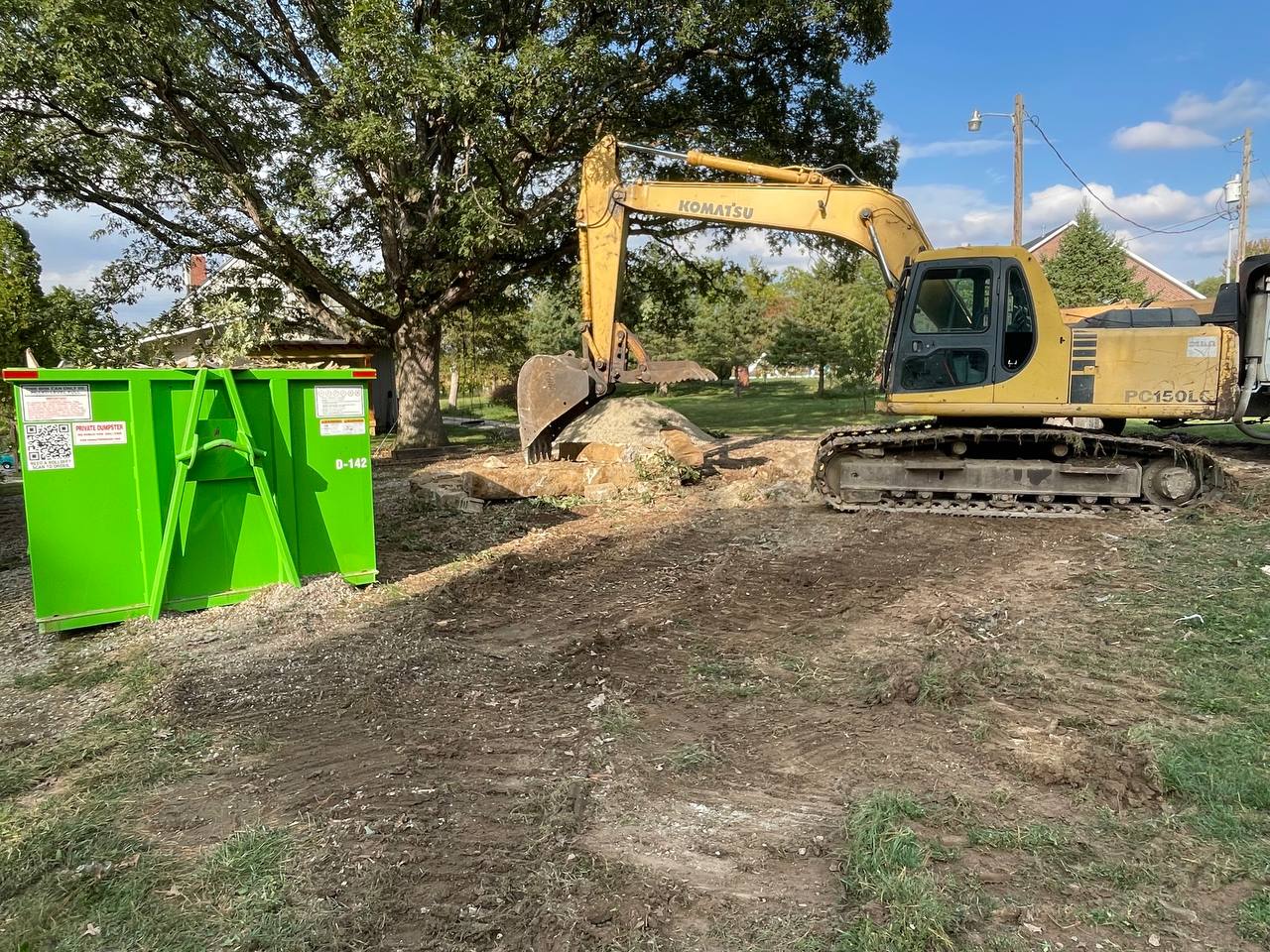
1. Size — Footprint and Stories
Square footage is the first thing people think of, and it matters, but it's the whole volume that drives the job. A sprawling single-story ranch and a tight two-story with a finished attic can have the same footprint and a very different amount of material. What we're really pricing is how much stuff has to come down, get processed, and get hauled off — and a tall house with an attached garage, porches, and additions holds a lot more than the footprint suggests.
2. How It's Built
Construction type is one of the biggest swings in the whole job.
- Stick-framed wood homes are the most common and the most straightforward to bring down.
- Brick or masonry walls add weight, dust, and a lot more disposal than a frame house.
- Block-and-poured-wall basements are tougher and slower to break out than a simple slab.
- Add-ons and mixed construction — a frame house with a brick addition and a concrete porch — get priced by the part that's hardest, not the easiest.
3. The Basement and Foundation — A Big Variable
This is the question people forget to ask, and on a house it's often the single biggest swing in the price. A slab-on-grade home is one thing. A full basement with poured or block walls is another — that concrete has to be broken out, the hole has to be backfilled with clean fill, and the ground has to be compacted so it doesn't settle later.
If you're rebuilding on the same spot, the basement usually comes all the way out and the pad gets prepped clean. If you're returning the ground to lawn or field, sometimes a partial removal and proper backfill works. Either way, foundation and basement removal is its own line item — and where there's a lot of concrete, that's where our concrete removal and haul-off come in. We quote it both ways so you can decide.
4. Asbestos and Lead — Be Honest, Not Scared
Older homes can contain regulated materials. Asbestos shows up in some old siding, floor tile, pipe wrap, and insulation, and lead paint is common on anything painted decades ago. This isn't a reason to panic, but it is a reason not to cut corners.
Testing and any required abatement add cost, but skipping them isn't an option on a home that has it. Plenty of houses come back clean, too — and then it's a non-issue.
5. Access, Debris Volume, and Haul Distance
The last big variables are about logistics, and they're easy to overlook.
- Access. Can we get an excavator and dump trucks right up to the house, or is it crowded against a neighbor, close to power lines, or hemmed in by trees and other buildings? Tight access slows everything down.
- Debris volume. A house is a lot of material — framing, roofing, drywall, brick, concrete, fixtures. The more there is, the more loads roll out the driveway.
- Haul distance. Everything that comes down has to go somewhere. The farther the nearest landfill or transfer station, the more truck time and tipping fees stack up. Out in the country that distance can be real.
6. Site Cleanup and Final Grade
The job isn't done when the house is gone. Once the structure's down and the basement's handled, the lot usually needs to be graded smooth, the debris field cleaned up, and the ground left ready for whatever's next — lawn, a new build, or just clean dirt. How much finish grading you want is part of the conversation, and it's worth deciding up front. You can read more on our full demolition service page.
So Why Won't I Just Quote a Number Here?
Short version, repeated from the top of the page because it is the part people actually came for: because I would be lying to you. Every one of the six things above moves the number, and I cannot see any of them from here.
What I can promise is that the number I give you after walking the site is the real one — itemized, honest, and free. You'll know what's coming down, whether the basement's included, what we're hauling, and how the lot gets left. No surprises on the invoice. If you've already got a house you're sure about, text a photo and we'll get you a straight answer.
"We hired Levy for a large demo job and dirt removal. They showed up on time, worked hard, and completed the job faster than I expected. What impressed me most was how clean they left the site afterwards — no mess left behind."
"Great Service and Great Price! They continued working for 3 days to demolish three buildings and removed all the debris to dumpsters that I ordered. Then, they also came in with dirt to fill the whole backyard. Strongly recommended!"
"Very responsive, fair pricing, and easy to work with. Did a great job for our project."
Every one of these is a real Google review from a real central Illinois customer — see them all on our reviews page.