Yard drainage isn't one fix — it's a handful of tools, and what it takes rides on which one your yard actually needs. The drivers are fix type (a regrade with no pipe versus a French drain plus catch basin and tile), pipe length, depth, how far off the outlet is, equipment access, and gravel and backfill. Anybody who throws a flat number without seeing your yard is guessing. The walk is free: (217) 809-0779.
"What's it cost to fix the standing water in my yard?" We get that call a lot — somebody's got a soggy spot that won't dry, a backyard that ponds after every rain, or a foundation that's always damp. The first question is always the same, and the honest answer is: it depends on where the water is coming from — and anybody who throws a flat number without seeing your yard is guessing.
Yard drainage isn't one fix — it's a handful of tools, and the right one depends on your yard. Here's what actually moves the yard drainage cost number, and why the honest answer always starts with walking the ground. You can also read our full drainage contractor page.
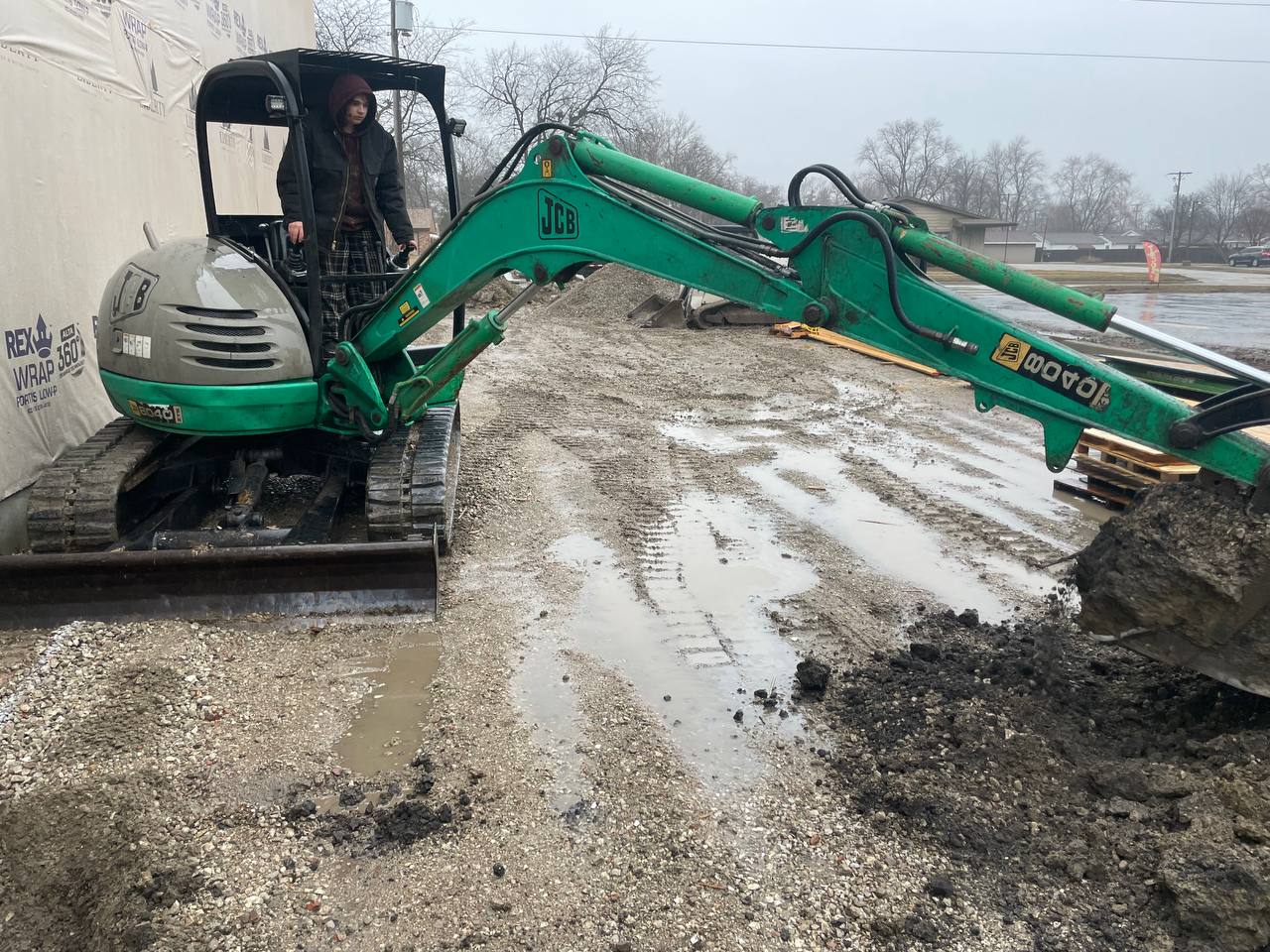
The Biggest Cost Factor: What Kind Of Fix
The single thing that changes the price more than anything else is what kind of drainage fix your yard actually needs. Here's what each one involves:
Regrading — The Simplest Fix
If the water is sitting on the surface because the ground slopes toward the house or there's a low spot that ponds, regrading to restore positive slope away from the foundation is often the cheapest fix. No pipe, no gravel — just reshaping the ground with a skid steer or mini-ex so water sheds instead of ponding. Works when the problem is surface water and the grade can be fixed.
Catch Basin + Short Pipe Run
A catch basin is a box set in the ground at the low spot that collects surface water and pipes it away through a solid pipe to an outlet — a ditch, a daylight spot, or a storm drain. Quick to install, targeted, and effective for a single low spot that collects runoff. Usually the middle ground on cost.
French Drain — For Saturated Soil
If the ground stays soggy and spongy with no standing water — that's groundwater, and a regrade or catch basin won't fix it. A French drain is a perforated pipe in a gravel-filled trench that intercepts the water below the surface and carries it to an outlet. More trenching, more gravel, more pipe — but it's the right tool when the problem is in the soil, not on top of it. See our French drain page.
Yard Drain Tile — The Full System
Big yards with multiple wet spots, saturated clay soil, and no good outlet often need a system — multiple tile runs tied to a main line that outlets to a ditch or creek. This is the most involved option and the most expensive per job, but it's also the one that fixes the problem permanently instead of just moving it around.
What The Fix Costs In Real Terms
We don't post flat prices because two yards that look similar in a photo can be different jobs once you account for the soil, the outlet, and the access. But here's the general shape:
- Regrading a low spot — the simplest fix, usually the lowest cost. A skid steer reshapes the ground so water drains away from the house.
- Catch basin + pipe to daylight — middle ground. Collects surface water at the low spot and pipes it out.
- French drain along a foundation or across a yard — more involved. Trenching, gravel, perforated pipe, and an outlet. Cost scales with length.
- Full yard tile system — the most involved. Multiple runs, a main line, and a real outlet. Fixes the whole yard, not just one spot.
The only honest way to quote any of these is to walk the yard. We do that free — call (217) 809-0779.
Why A Site Walk Beats A Web Page
Because two yards that look identical in a photo can need completely different fixes. One might need a regrade; the other might need 150 feet of French drain and a catch basin. The soil, the slope, the outlet, the access, and where the water actually is — those are things you only see on the ground.
What I can promise is that after I walk your yard, the number is the real one: what kind of fix, how much pipe and trenching, where the outlet goes, and what it costs — itemized, honest, and free.
Want it fixed? See our yard drainage contractor page, or call and we'll come look at it.