Just want the pole barn down? This page explains what moves the price. If you are ready to book the work, our pole barn demolition page has the crew, the equipment, and a free on-site walk — or call (217) 809-0779 and talk to Levi.
Pole barn demolition cost turns on six things: size and eave height, whether there is a concrete floor and whether it comes out, pulling the posts out of their footings, the steel skin and framing (scrap value works in your favor), asbestos on the genuinely old ones, and access plus haul distance. A newer steel building on a slab is a different job than a 1950s post frame. The site walk and the itemized number are free: (217) 809-0779.
If you're looking for pole barn demolition contractors near you in central Illinois, start with the good news: a pole barn is about the easiest building we tear down. Post-frame construction is light and simple — there's no heavy masonry, no timber-frame beams to bring down careful, just a metal-clad frame on posts. So if you've got a tired old machine shed or a hail-beat pole building you want gone, it's usually one of the lower-cost demolition jobs on the menu.
That said, "cheapest" still isn't a single number, and anybody who quotes you off a photo without asking three questions is guessing. Here's what actually decides the cost of taking a pole barn down in central Illinois.
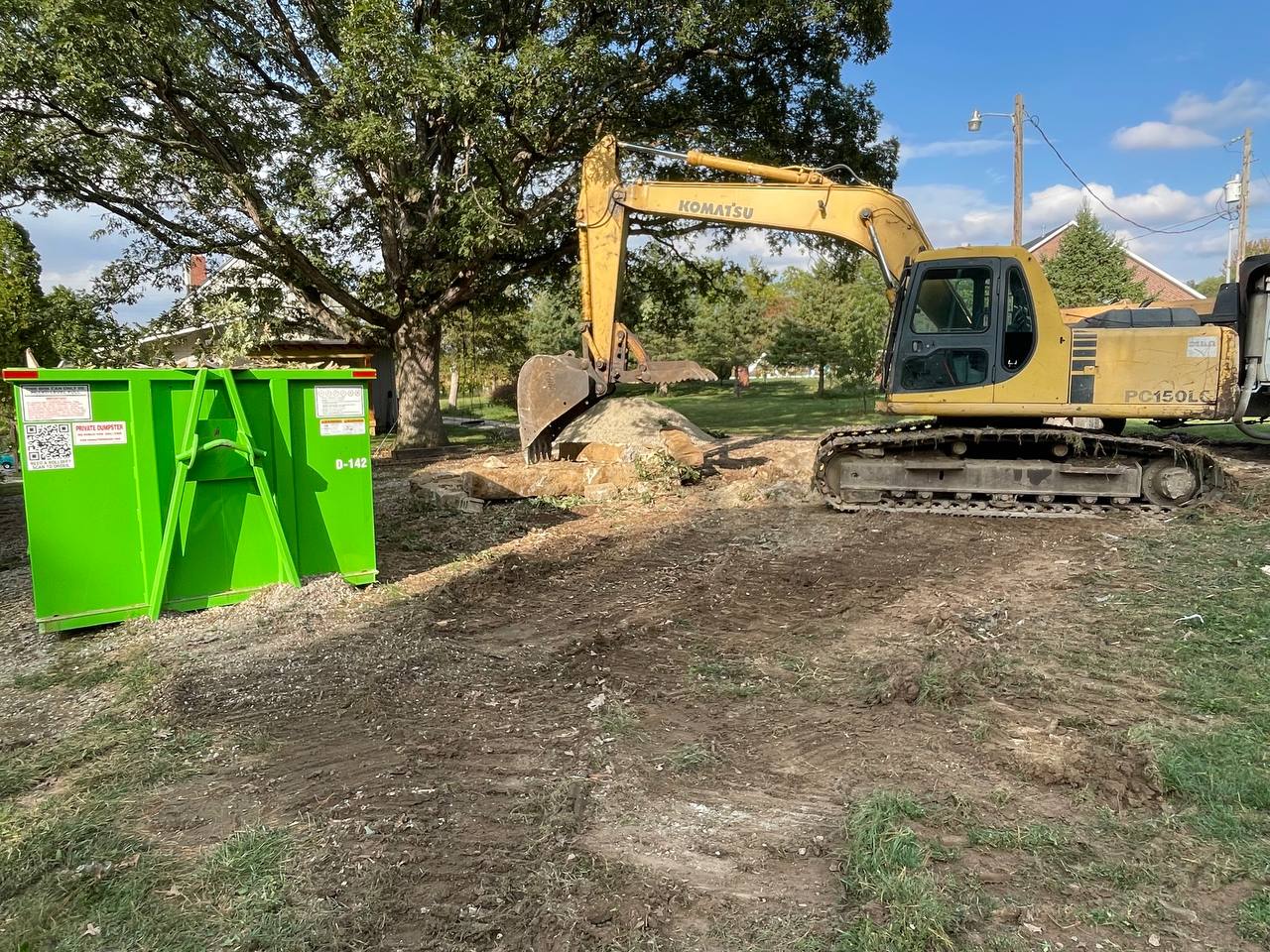
1. Size and Height
Footprint matters, but so does how tall it is and how much building is up in the air. A low 24×30 backyard pole barn is a quick job. A tall 60×120 ag building with big sidewalls and a clear-span truss roof is a lot more material to bring down, process, and haul — even though it's still "just a pole barn." What we're pricing is how much steel and frame has to come down and get loaded out, and a big ag building holds a lot more than a small one.
2. The Concrete Floor — If There Is One
This is the question that swings a pole barn job the most. A lot of pole barns sit on bare dirt or gravel, and those come down clean and quick. But plenty have a poured concrete floor, and that changes things.
If there's a slab and you want it gone — because you're rebuilding, or you want the ground back to clean field — that concrete has to be broken out and hauled, and that's its own line item. If you're leaving the slab, we can sometimes just take the building off the top of it. Either way it's worth deciding up front, because it's often the biggest single variable. If there's a lot of concrete, our concrete removal and haul-off is where that part of the number comes from.
3. The Posts in Their Footings
Here's the part of a pole barn people forget: the posts are in the ground. Post-frame buildings are held up by columns set several feet down in concrete footings, or in some cases buried treated posts. When the building comes down, those posts and footings are still in the dirt.
- If you're returning the ground to clean field or pasture, or rebuilding on the spot, the posts and footings usually get dug and pulled so there's nothing left to hit with a tiller or a new foundation.
- If the ground use doesn't need it, sometimes we cut them off below grade and backfill, which is less work.
It's not a huge cost, but it's a real one, and it's the difference between "the building's gone" and "the ground's actually clean." We'll ask which one you need.
4. The Metal — Working In Your Favor
This is the side that can knock the number down. A pole barn is mostly steel — roofing, siding, and the structural steel and fasteners — and clean metal has scrap value.
It doesn't always add up to much on a small building, and beat-up, painted, or screwed-down-tight panels take labor to strip. But on a large ag building, the metal is worth recovering — and that's a Brohez angle we lean into.
5. Asbestos — Usually Not, But Check the Old Ones
Most pole barns are newer metal buildings with little asbestos concern. But an older one, or one with added insulation board, panels, or a finished interior, can still have regulated material. This isn't a reason to panic — most pole barns come back clean — but on an older building it's worth a look.
Where asbestos is a real concern, a licensed inspector should check before demolition, and any regulated material has to be handled properly. We help you line that up. (More on the rules in our post on demolition permits in Illinois.)
6. Access and Haul Distance
The last variables are logistics. Can we get a machine and trucks right up to the building, or is it boxed in by other structures, close to power lines, or tucked behind trees? And how far is the nearest landfill or transfer station — out in the country, that haul distance adds truck time and tipping fees. A pole barn standing alone in a field with a county road right there is the easy case; one wedged between the house and the grain setup is more careful work.
Hiring a Pole Barn Demolition Contractor — Why the Number Comes From a Site Walk
Because two pole barns that look the same in a photo can be a good ways apart once you account for the floor slab, the footings, and how much metal there is to recover. A number off a web page is a guess dressed up as an answer.
What I can promise: the number I give you after walking the site is the real one — itemized and free. You'll know whether the slab and posts are included, what we're hauling, and what the scrap knocks off the top. No surprises on the invoice. Read more on our pole barn demolition page, or send a couple photos and we'll get you a straight answer.
"We hired Levy for a large demo job and dirt removal. They showed up on time, worked hard, and completed the job faster than I expected. What impressed me most was how clean they left the site afterwards — no mess left behind."
"Great Service and Great Price! They continued working for 3 days to demolish three buildings and removed all the debris to dumpsters that I ordered. Then, they also came in with dirt to fill the whole backyard. Strongly recommended!"
"Very responsive, fair pricing, and easy to work with. Did a great job for our project."
Every one of these is a real Google review from a real central Illinois customer — see them all on our reviews page.