Just want the garage gone? This page explains what moves the price. If you are ready to book the work, our garage demolition page has the crew, the equipment, and a free on-site walk — or call (217) 809-0779 and talk to Levi.
Knock down garage, demo garage, tear down garage — same job. What moves the cost is size (1-car, 2-car, or 3-car), attached or detached, whether the slab and footings come out, what's still stored inside, access for a machine and a truck, and haul distance. A 2-car garage on an open lot is usually a one-day job. We quote it slab-in and slab-out so you can pick. Free on-site walk: (217) 809-0779.
Why won't you just put a price on this page?
Because a number on a web page is a guess, and you would build your plan on it. Two 2-car garages that look the same from the street can land a long way apart once you know whether the slab and footings are coming out, whether it is tied to the house, and whether a truck can actually get to it. What I will promise instead: I walk it, and you get the real number itemized and free — quoted slab-in and slab-out so you can pick. Text a photo or call (217) 809-0779. The six things below are what that walk is looking at.
"Who knocks down a garage around here, and what does it cost?" It's one of the most common demolition calls we get — a leaning detached garage, a one-stall that came with the house and needs to go, a two-car with a sagging roof. And the answer is the same one I give on the phone: the honest answer is it depends — and anybody quoting you a flat price off a website without seeing it is guessing.
The good news is a garage is a smaller, more predictable job than a house, so the variables are easy to understand. Whether you call it tearing it down, demolishing it, demoing it, or knocking it down, the cost to demolish a garage comes down to the same handful of factors. Here's what actually moves the cost of garage demolition in central Illinois.
This page is the explainer, not the booking page. If you already know what you've got and just want it torn down, our garage demolition service page covers the crew, the equipment, and the towns we cover — Mattoon, Charleston, Effingham, and the rest of the 60-mile radius. And if what you've actually got is a backyard shed rather than a garage, that's a different job with a different number: read the shed teardown guide instead.
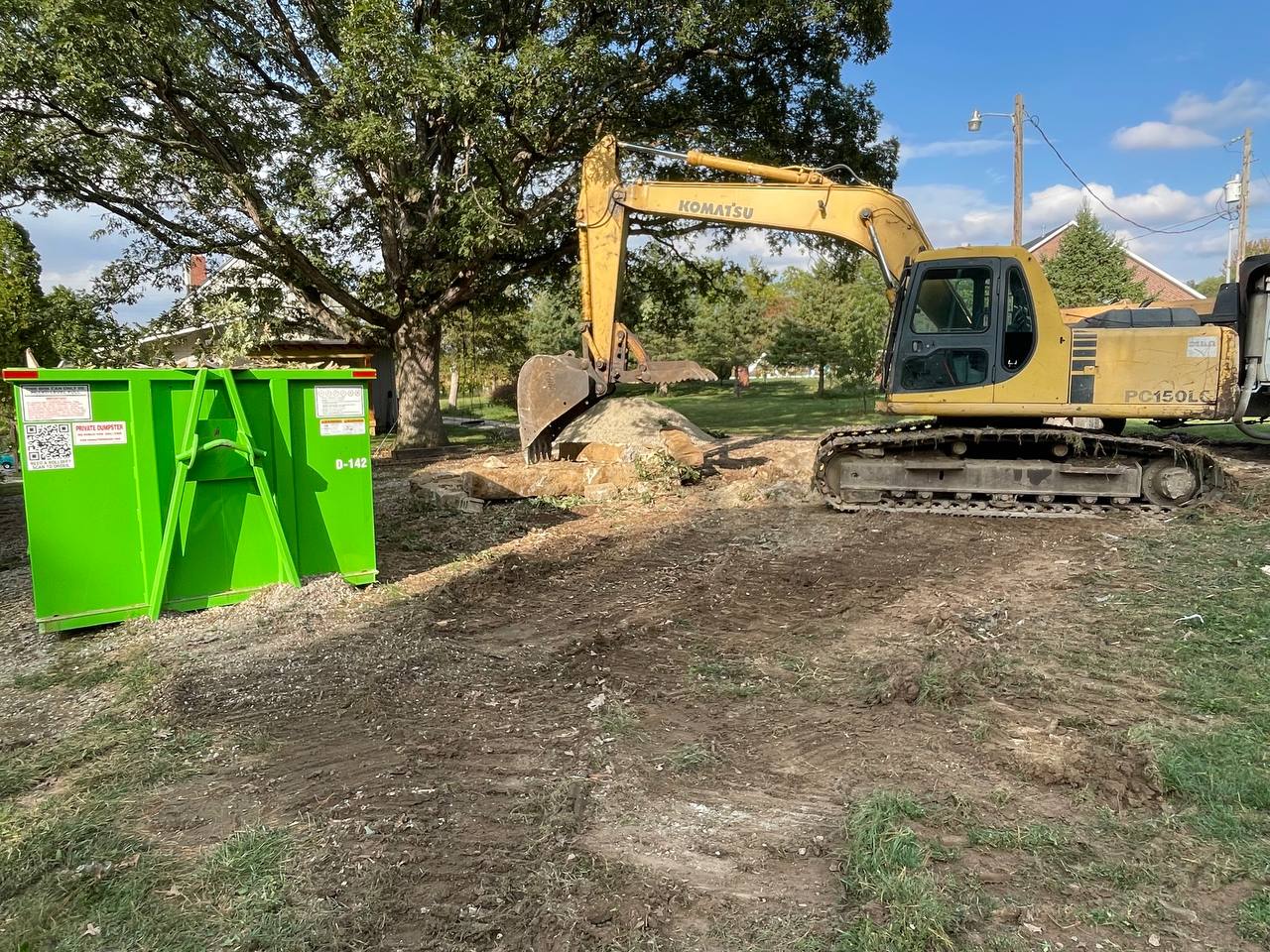
1. Size and Type
A single-stall detached garage and a big three-car with a loft are two different jobs. Footprint matters, but so does height and how much is packed into it. What we're really pricing is how much material comes down and gets hauled off — a tall garage with a second-story loft holds far more than its footprint suggests.
1-Car, 2-Car, or 3-Car — What Each One Means for the Job
Most people describe their garage by how many cars fit in it, so here's how each size actually reads on the job:
- 1-car / single-stall. The smallest garage demo we do. Structure down, slab out, hauled off — usually a half-day on an open lot, and often the same trip as another small teardown on the property.
- 2-car garage. The most common call we get. A two-car garage is roughly double a single-stall in framing, roofing, and siding, and the slab plus the apron is real concrete tonnage once it's broken out. Still a one-day job on an open lot with the truck able to back in. Attached two-car garages take longer because the shared wall has to be cut free and closed back in.
- 3-car and oversized. More material, more loads, and often a loft or storage space above that holds a surprising amount. Deeper footings and thicker slabs show up more on these too.
Whether you call it a two-car garage or a 2-car garage, the number rides on how much comes down and gets hauled — not on a per-square-foot figure off a web page.
2. How It's Built
Construction type is a real swing even on a small building.
- Light frame and metal garages come down fast — simple frame, light material, not much to it.
- Stick-framed garages are straightforward but heavier, with roofing, siding, and framing to process.
- Block or brick garages add weight, dust, and a lot more disposal than a wood building.
- Lean-tos and add-ons stuck on the side get priced by the part that's hardest, not the easiest.
3. The Slab — Does It Come Out?
This is the question people forget to ask, and on a garage it's often the biggest single decision. Most garages sit on a poured concrete slab, sometimes with an apron out front and footings under the walls.
If you're rebuilding on the same spot, the old slab usually has to come out and the ground gets prepped clean. If you just want the structure gone and the slab doesn't bother you, sometimes it can stay. Either way, slab removal and haul-off is its own line item — and where there's a lot of concrete, that's where our concrete removal work comes in. We always quote it both ways so you can decide.
4. Attached vs. Detached
A freestanding garage out in the yard is the simplest case. An attached garage is more careful work — it has to be cleanly separated from the house, and the wall it shared has to be closed back in so the home is weather-tight. That separation and patch-in adds time and cost, and it's worth flagging up front.
5. Asbestos and Lead — Be Honest, Not Scared
Even small buildings can contain regulated materials. Asbestos shows up in some older roofing, siding, and floor tile, and lead paint is common on anything painted decades ago. This isn't a reason to panic, but it is a reason not to cut corners.
Plenty of garages come back clean, and then it's a non-issue. But on a building that has it, skipping the step isn't an option.
6. Access, Debris, and Haul Distance
The last variables are about logistics.
- Access. Can we get a machine and a truck right up to it, or is it boxed in behind the house, close to a fence, or under power lines? Tight access slows the job.
- Debris volume. Everything that comes down has to be loaded and hauled. A packed-full garage is more material than an empty one — clearing out what's stored inside first helps.
- Haul distance. The farther the nearest landfill or transfer station, the more truck time and tipping fees add up. In the country that distance can matter even on a small job.
Does A "Knock Down" Cost Less Than A "Demo"?
People call it different things depending on where they grew up, and it trips folks up when they're comparing contractors. To be plain about it, they all describe the same work and they all cost the same — bring the structure down, decide on the slab, load it out, haul it off, grade the spot. Nobody prices a "knock down" differently than a "demo." The naming is covered on our garage demolition page; this guide sticks to what moves the number.
What does change the number is what you want left behind. A demo that stops at "structure gone, slab stays" is a different scope than "slab out, footings out, ground graded and seedable." Both are normal requests. Tell us which one you're after and we'll quote it that way — and we'll quote the other way too, so you can see what the difference actually is before you decide.
So Why Won't I Just Quote a Number Here?
Because I'd be lying to you. Two garages that look the same in a photo can be far apart once you account for the slab, whether it's attached, what's in the walls, and how far the debris travels. A number off a web page is a guess dressed up as an answer.
What I can promise is that the number I give you after walking the site is the real one — itemized, honest, and free. You'll know what's coming down, whether the slab's included, and what we're hauling. No surprises on the invoice. Got a garage you're sure about? Text a photo and we'll get you a straight answer. Our full garage demolition page has the towns we cover and the equipment we bring.
"We hired Levy for a large demo job and dirt removal. They showed up on time, worked hard, and completed the job faster than I expected. What impressed me most was how clean they left the site afterwards — no mess left behind."
"Great Service and Great Price! They continued working for 3 days to demolish three buildings and removed all the debris to dumpsters that I ordered. Then, they also came in with dirt to fill the whole backyard. Strongly recommended!"
"Very responsive, fair pricing, and easy to work with. Did a great job for our project."
Every one of these is a real Google review from a real central Illinois customer — see them all on our reviews page.